

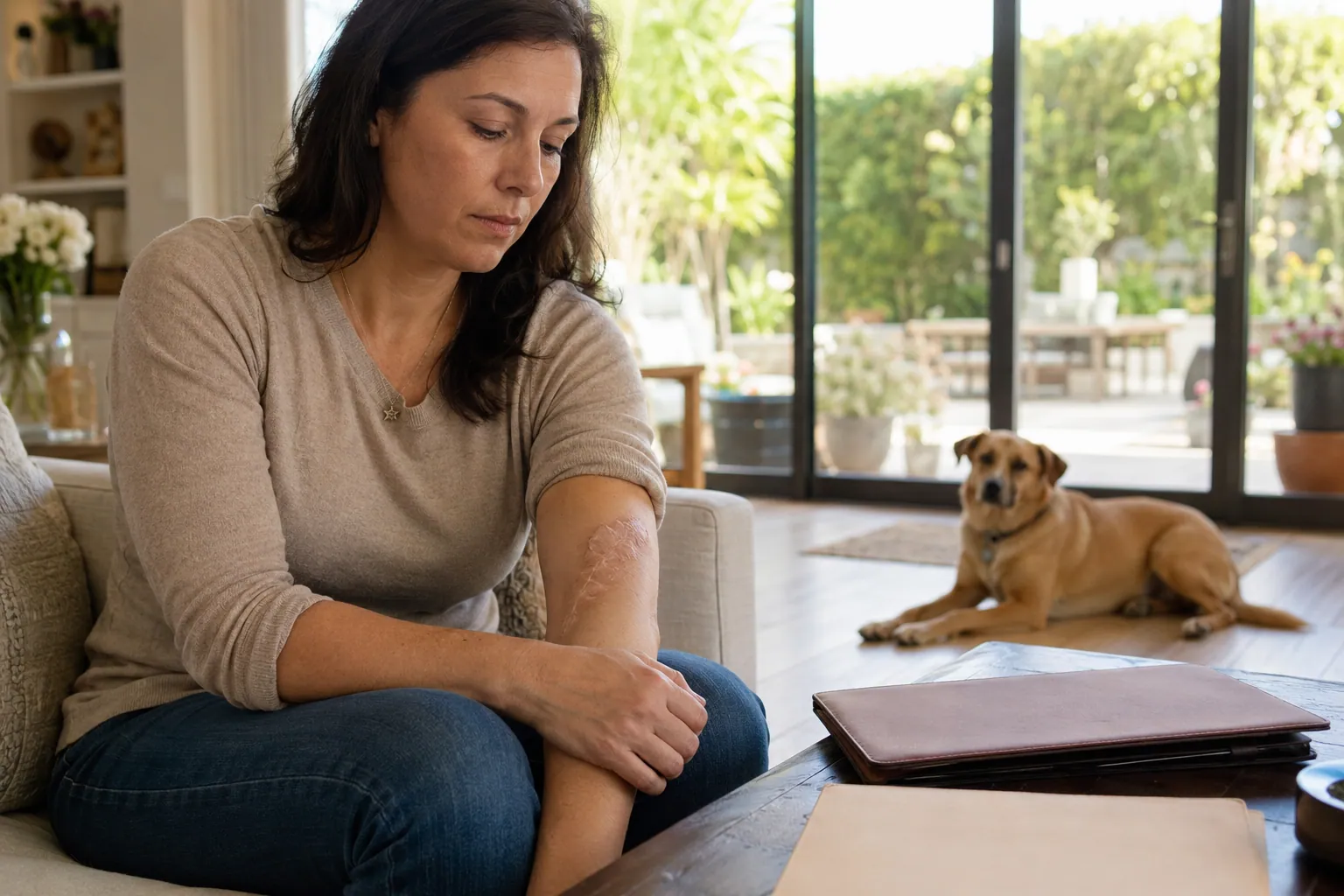
A dog bite that leaves scarring or disfigurement is not a minor case, even when the initial medical bills look small. Under California law, scarring and disfigurement are separately compensable, and in serious cases they often exceed the medical costs by a wide margin.
This article walks through how California treats dog bite scarring claims, what damages are recoverable, and the deadlines that apply.
California Uses Strict Liability for Dog Bites
Most states use a “one bite” rule that gives the owner of a dog with no prior history of biting a partial defense to the first attack. California does not. Under California Civil Code §3342, a dog owner is strictly liable for any bite that occurs in a public place or when the victim is lawfully on private property, regardless of whether the dog has ever bitten anyone before or shown any prior aggression.
The elements of the claim are set out in California Civil Jury Instruction CACI 463: the defendant owned the dog, the dog bit the plaintiff while in a public place or lawfully on private property, the plaintiff was harmed, and the dog was a substantial factor in causing that harm. Prior knowledge of dangerousness is not required.
Strict liability under §3342 covers actual bites. Other injuries caused by dogs, being knocked down, chased into traffic, causing a fall, fall under general negligence principles, which do require some showing of fault on the owner’s part.
Scarring and Disfigurement Are Their Own Category of Damages
California recognizes two categories of compensatory damages, plus a separate category of punitive damages in narrow cases.
Economic damages are the documentable financial losses: emergency care, wound closure, plastic surgery consultations, scar revision procedures, dermabrasion, laser treatment, follow-up care, psychological counseling if PTSD is diagnosed, lost wages, and out-of-pocket expenses. For a scarring case, economic damages should include not just what has already been spent, but the projected future cost of scar revision, which often continues for years and, in the case of a child, may need to be repeated as the child grows.
Non-economic damages under California Civil Jury Instruction CACI 3905A separately cover physical pain, mental suffering, emotional distress, loss of enjoyment of life, physical impairment, inconvenience, anxiety, humiliation, and disfigurement. Scarring, altered appearance, and permanent visible marks are called out as their own compensable harm. CACI 3905A tells the jury directly that “no fixed standard exists” for calculating these damages; the jury uses judgment based on the evidence.
Punitive damages under California Civil Code §3294 are a separate category available in narrow cases involving malice, oppression, or fraud. In a dog bite context, punitive damages may be considered when the owner had actual knowledge of prior aggression and continued to keep the dog unrestrained, or when the incident involved intentional misuse of the dog.
What Actually Drives Scarring Case Value
The scarring itself is only part of the story. Four factors do most of the work in valuing a serious dog bite scarring case.
- Location on the body. Face, neck, hands, and other visible areas carry substantially higher values than areas ordinarily covered by clothing. Permanent visible scarring changes daily life in ways that hidden scarring does not.
- Age of the victim. Scarring on a child, especially facial scarring, carries a longer time horizon of impact and often requires multiple revisions as the child grows.
- Permanence and revision potential. Detailed treatment plans from plastic surgeons, including realistic assessments of what revision can and cannot achieve, drive the number more than the raw medical bills do.
- Documented psychological impact. PTSD, anxiety, avoidance of animals, sleep disruption, and social withdrawal are all separately compensable under CACI 3905A. Consistent documentation with a treating professional strengthens this component.
Landlord and Public-Entity Liability
In many California dog bite cases, the owner has minimal or no insurance. Additional avenues of recovery exist in specific situations.
Under the line of California cases including Donchin v. Guerrero, Uccello v. Laudenslayer, and Portillo v. Aiassa, a landlord may share liability when the landlord had actual knowledge of a tenant’s dangerous animal, had the ability to remove or restrict the animal, and failed to do so. This opens the landlord’s insurance policy as an additional source of recovery.
A dog bite involving a K-9 police dog, a dog owned by animal control, or an attack in a public park (with a public-entity duty to enforce leash laws) triggers the California Government Claims Act, with a six-month claim deadline under Government Code §911.2 rather than the two-year civil deadline.
The Deadline: Two Years, Except When It Is Six Months
Under California Code of Civil Procedure §335.1, the ordinary dog bite filing deadline is two years from the date of the bite. For minors, the statute is tolled under Code of Civil Procedure §352 until the child turns 18, generally giving the child until their 20th birthday to file the civil suit.
If a public entity is involved, the six-month Government Claims Act deadline runs from the date of the injury regardless of the victim’s age. This is a common trap in K-9 and public-park cases.
Bottom Line: The First Bill Is Never the Whole Case
California dog bite scarring cases are valued on the long-term human impact, not on the initial emergency room visit. A well-built case documents the full projected treatment plan, the location and permanence of the scarring, the psychological toll, and every source of recovery, the owner’s homeowners policy, landlord liability, and a public entity in the applicable cases.
Two deadlines matter. The ordinary two-year statute of limitations runs from the date of the bite. But if a K-9, animal control dog, or public-park bite is involved, the six-month dog bite filing deadline for public entity claims can close months earlier than most people expect.
Ravan Law reviews California dog bite cases for free with attorney Ted H. Ravan directly. You pay nothing unless we recover compensation. If your case involves scarring, especially facial scarring, a bite to a child, or any question of public-entity involvement, request your free case review today so the deadlines do not run out before the case is built.
Attorney Advertising. Ted Ravan, Ravan Law, Los Angeles, CA. This content is general information, not legal advice and does not create an attorney-client relationship. Every case depends on its specific facts.
