

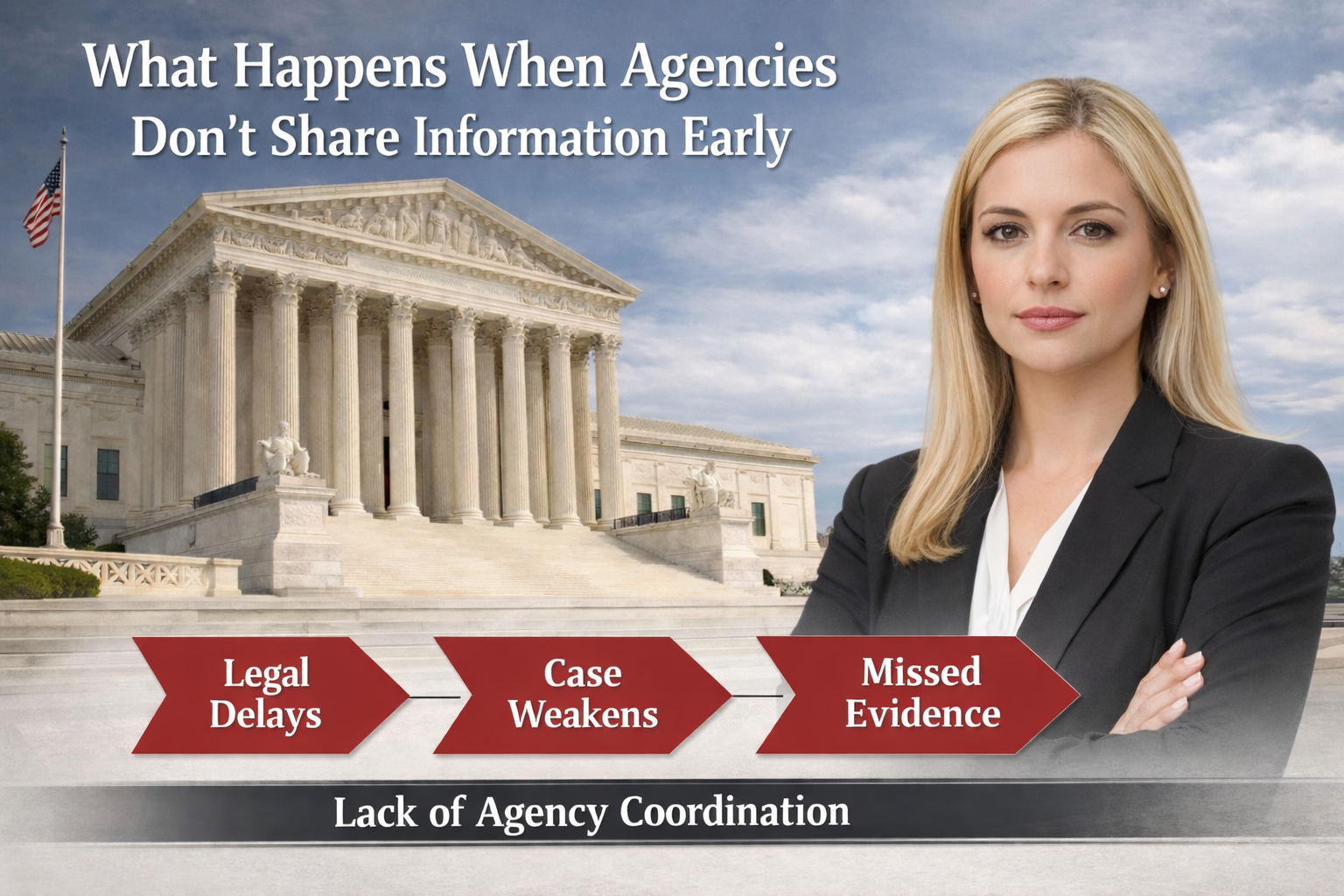
Most system failures are not dramatic.
They are quiet.
They begin with information that exists but does not move. A report sits in one place. A pattern is noticed in another. A third piece of context never connects to either.
By the time everything lines up, the outcome has already escalated.
In serious cases, the issue is rarely a lack of information. It is the delay in sharing it.
Information Exists Before It Connects
In many high-stakes cases, the key facts are already known somewhere in the system. Law enforcement has one piece. Another agency has a related record. A prior incident is documented but not flagged as part of a larger pattern.
Each piece is accurate on its own. The problem is that it stays isolated.
Research across criminal justice systems shows that fragmented information reduces early intervention opportunities. The Bureau of Justice Statistics has reported high rates of re-arrest among individuals with prior system contact, often tied to gaps in coordination and follow-up.
The system does not fail because it lacks data. It fails because it cannot see the full picture in time.
Delays Change Outcomes
Time matters more than volume.
When information is shared early, it can shape decisions. It can adjust response. It can prevent escalation. When it arrives late, it becomes context instead of prevention.
In violent cases, delays often mean that earlier warning signs are only recognized after the fact. A prior report that seemed minor becomes critical in hindsight. A missed connection becomes obvious only once the situation has worsened.
One prosecutor described reviewing a case where multiple agencies had documented separate incidents involving the same individual. Each report made sense on its own. None of them triggered a broader response until a more serious offense occurred.
“The file didn’t look incomplete,” he said. “It just wasn’t connected.”
That distinction is where risk grows.
Patterns Stay Hidden Without Coordination
Behavior patterns do not appear in a single report. They emerge across multiple interactions over time.
Without coordination, those patterns remain invisible.
In repeat offender cases, escalation often follows a recognizable path. Prior contact increases. Behavior intensifies. Interventions fail to align. Each step builds toward a more serious outcome.
The National Institute of Justice has emphasized that coordinated information-sharing improves early detection of risk factors, particularly in cases involving violence and repeat offenses.
Without that coordination, the same signals are treated as separate events rather than as a developing pattern.
Volume Makes the Problem Worse
High-volume systems struggle with attention.
Agencies process large numbers of reports, cases, and interactions daily. Under those conditions, information is often handled efficiently but not integrated.
Research on cognitive load shows that as volume increases, the ability to recognize connections decreases. This applies at both the individual and organizational level.
A case may be processed correctly within one system but still fail at the system level because no one sees how it connects to other cases.
“Everyone did their job,” one legal professional observed. “The system still missed the pattern.”
That is the core issue.
Communication Breakdowns Are Subtle
Breakdowns rarely come from a refusal to share information. They come from structure.
Different systems use different formats. Agencies operate on different timelines. Priorities vary.
These differences create friction.
A report may not reach the right person in time. A follow-up may not be triggered. A key detail may not be recognized as relevant outside its original context.
In many cases, the gap is not intentional. It is operational.
That makes it harder to fix.
Early Sharing Changes Decision Quality
When information moves early, decisions improve.
Prosecutors can assess risk more accurately. Law enforcement can adjust the response. Agencies can coordinate actions rather than react independently.
Early sharing allows for alignment.
It also reduces uncertainty. Instead of building a case from isolated facts, decision-makers work from a more complete view.
Bracken McKey, who spent decades prosecuting serious felony cases, has emphasized how often critical patterns only became clear once information from different sources was combined. The individual pieces rarely stood out on their own.
“You don’t see the risk in one report,” he noted in reflecting on long-term casework. “You see it when the reports line up.”
That alignment is what changes outcomes.
Missed Connections Lead to Escalation
When information is not shared early, escalation becomes more likely.
Minor incidents remain isolated. Patterns are not recognized. Opportunities for intervention are missed.
By the time the system responds to the full picture, the situation has often reached a more serious stage.
This pattern appears consistently in violent crime cases. Early warning signs exist but are not connected. Later events reflect the accumulation of those missed signals.
The cost is not just procedural. It is real.
Each missed connection increases the likelihood of a more severe outcome.
System Gaps Become Visible Over Time
Looking across multiple cases reveals consistent gaps.
Information is delayed.
Patterns are missed.
Responses are fragmented.
These gaps do not appear in a single case. They emerge across many.
Long-term exposure to serious cases makes them easier to see. The same breakdowns repeat in different contexts.
Once identified, they become difficult to ignore.
Coordination Is Not Complexity
Improving information sharing does not require adding complexity. It requires reducing friction.
Clear communication channels.
Defined points of contact.
Shared awareness of patterns.
These elements improve coordination without changing the core function of each agency.
The goal is not to centralize everything. It is to connect what already exists.
What This Reveals
Serious cases often reflect earlier moments where different information could have been connected.
The system does not lack knowledge. It lacks timing.
When agencies share information early, patterns become visible. Decisions improve. Outcomes shift.
When they do not, the same patterns remain hidden until the cost increases.
The difference is not dramatic.
It is sequential.
And in high-stakes environments, sequence determines outcome.
