

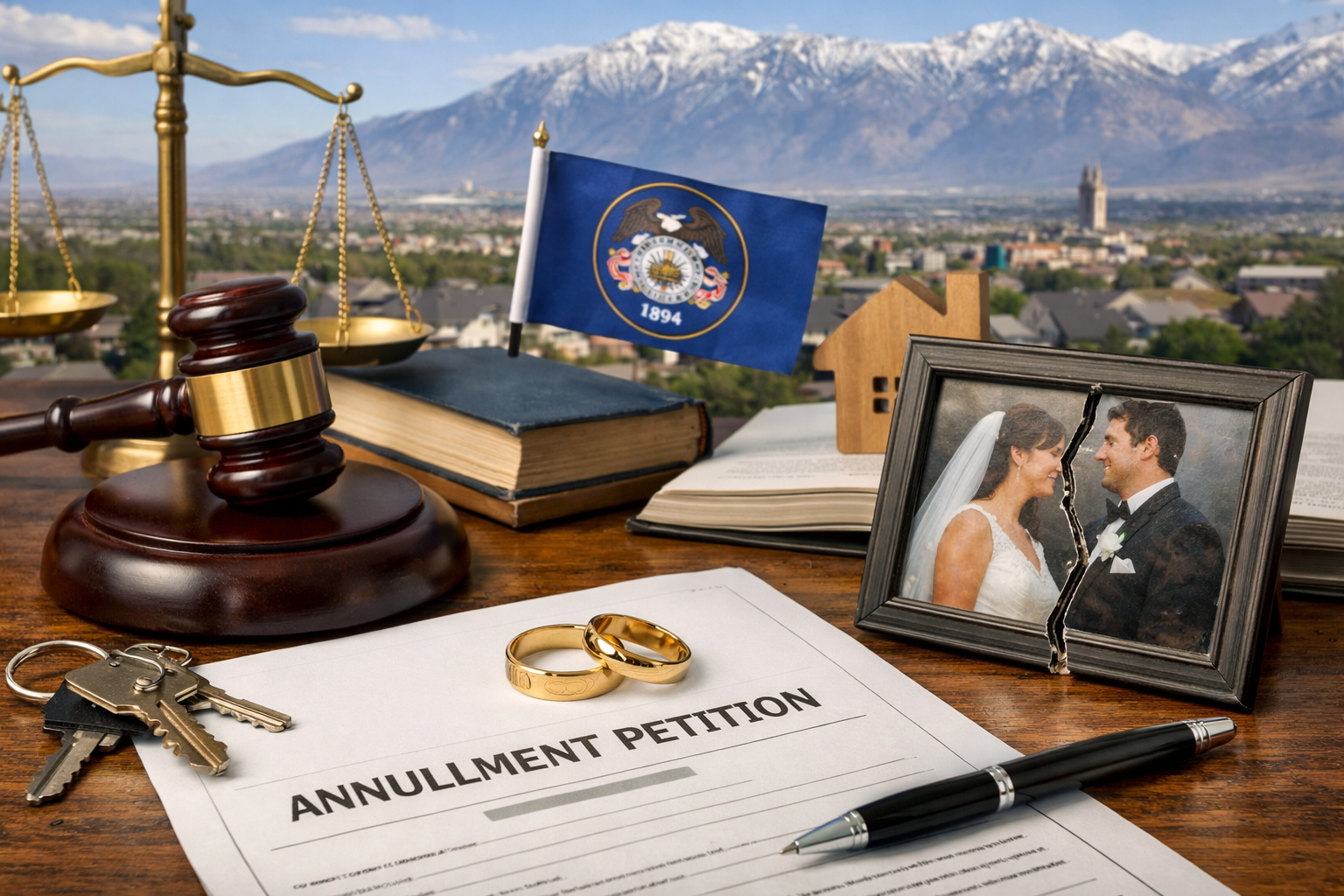
Annulment in Utah can feel confusing and heavy. You may wonder if your marriage can be treated as if it never legally happened. You may also worry about children, money, and your future. This guide explains how annulments work under Utah law and when they are possible in Lehi courts. You will see what the law actually allows, what proof a judge looks for, and how annulment differs from divorce. You will also learn what happens with custody, support, and property when a marriage is erased. This information is not a substitute for legal advice. It gives you a clear starting point so you can ask better questions and protect yourself. You can then decide whether to talk with a lawyer, visit a court self help center, or review official forms and instructions on a court website.
What an Annulment Does in Utah
An annulment is different from a divorce. A divorce ends a valid marriage. An annulment says the marriage was not valid from the start under Utah law.
After an annulment, the law treats you as if you were never married. You return to single status. You can marry again if you choose. The court can still handle issues like custody and support. The judge does not erase your children or your shared life. The judge only rules on the legal status of the marriage.
When Utah Courts Allow an Annulment
Utah law lists specific reasons that can support annulment. A judge in Lehi uses the same statewide rules. You cannot get an annulment just because the marriage felt short or unhappy. You must show a legal ground.
Common grounds can include:
- One person was already married to someone else at the time
- One person was underage and the law did not allow that marriage
- Close blood relation that Utah law bans
- Fraud about a basic part of the marriage, such as identity or intent to marry
- One person lacked the mental ability to agree
- Serious pressure or force used to make someone marry
The judge will need proof. That can be records, messages, or witness statements. A simple claim without support will not work.
Annulment vs Divorce in Utah
You might feel torn between seeking an annulment or a divorce. The short answers below can help you sort out the differences.
| Topic | Annulment in Utah | Divorce in Utah
| |
|---|---|---|---|
| Legal effect | Marriage treated as if it never existed | Marriage ends from the date of divorce decree | |
| Grounds needed | Specific legal grounds like fraud, bigamy, or underage marriage | No fault grounds like irreconcilable differences | |
| Ease of proof | Often harder to prove | Often simpler to prove | |
| Property division | Court can still divide property and debts | Court divides marital property and debts | |
| Children | Court orders custody, parent time, and support | Court orders custody, parent time, and support | |
| Future marital status | Treated as never married to that person | Treated as divorced from that person |
You can read Utah’s general marriage and divorce laws on the Utah Legislature site at https://le.utah.gov/.
Special Issues for Lehi Residents
If you live in Lehi, your annulment case will usually go through the Utah District Court that serves Utah County. The same state laws apply. The process can still feel personal because it affects your home, your children, and your day to day life in Lehi.
You will need to file in the right court. You will also need to serve the other person with the papers. The judge may set hearings in a courthouse that you can reach from Lehi within a short drive. You might also appear by remote video in some cases if the court allows it.
How the Court Handles Children and Money
Many people fear that an annulment will harm their children. Utah law does not punish children for the legal status of their parents. The court can still order:
- Legal and physical custody
- Parent time schedules
- Child support and sometimes spousal support
The judge can also divide property and debts. That can include homes, cars, bank accounts, and loans. The court looks at fairness. The court does not ignore your shared life just because it voids the marriage.
Basic Steps to Seek an Annulment in Utah
The Utah State Courts offer public guides on annulment and related issues at https://www.utcourts.gov/. You can use that site to check forms and procedures. The process often includes these steps:
- You confirm that a legal ground for annulment might apply to your facts.
- You gather records, messages, and any witness names that support your claim.
- You file a petition for annulment in the correct Utah District Court.
- You arrange for proper service of the papers on the other person.
- You attend hearings and follow court orders for classes or mediation if required.
- You present proof to the judge. The other person can respond and present proof.
- You receive a court order that either grants or denies the annulment.
You can ask for temporary orders during the case. These can cover custody, support, and use of the home while the case is open.
When You Might Choose Divorce Instead
Sometimes the facts do not fit the tight rules for annulment. In those cases, divorce is often the only path. You might choose divorce if:
- You cannot show fraud, bigamy, or another listed ground
- You feel rushed and do not want a long proof fight
- You want a clear and quick end to the marriage
The choice between annulment and divorce is not only legal. It is also personal and spiritual. You might care about how your faith community views each option. You might also care about how you explain your past to your children and family.
How to Protect Yourself in a Utah Annulment
You can protect yourself in three main ways. First, learn the law so you know what the judge must see. Second, keep records so you can back up your story with proof. Third, seek help when you feel stuck.
You can speak with a lawyer even for a short consult. You can visit a Utah court self help center or a legal clinic. You can also review official guides from Utah courts and laws from the Utah Legislature site. These steps will not erase your pain. They will give you control and a plan for the next step.
